.svg "header-logo")


Rather than outsourcing the entire transformation program, businesses can use external teams to manage selected technology, operational or support functions and reduce the pressure competing priorities place on digital initiatives.
That capacity is becoming increasingly important as technology reshapes business models and workforce requirements. IDC forecasts that global digital transformation investment will reach almost $4 trillion by 2028.[1] Meanwhile, the World Economic Forum found that 60% of surveyed employers expect broadening digital access to transform their business by 2030, while 63% identify skills gaps as a major barrier to business transformation.[2]
For organizations facing those constraints, outsourcing can provide another way to access talent, scale teams and create space for internal employees to concentrate on strategy, change management and innovation. The value is not simply reducing costs; it is building the workforce capacity needed to turn digital transformation plans into sustained operational change.
Content Guide
- What does digital transformation mean for businesses?
- How does outsourcing support digital transformation?
- What are the benefits of outsourcing for digital transformation?
- How can businesses manage outsourcing risks during digital transformation?
- Which roles can businesses outsource to support digital transformation?
What does digital transformation mean for businesses?
Digital transformation is the ongoing use of digital technologies to improve how a business operates, delivers services and creates value for customers. It can involve modernizing systems, redesigning processes, improving access to data or developing new products and services.
The work extends beyond implementing a new platform. Employees need to understand how to use it, processes may need to change and leaders need to determine whether the investment is delivering the intended outcome.
For example, introducing a customer relationship management system is a technology project. Connecting that system to sales workflows, improving data quality and using the information to deliver more consistent customer service makes it part of a broader transformation.
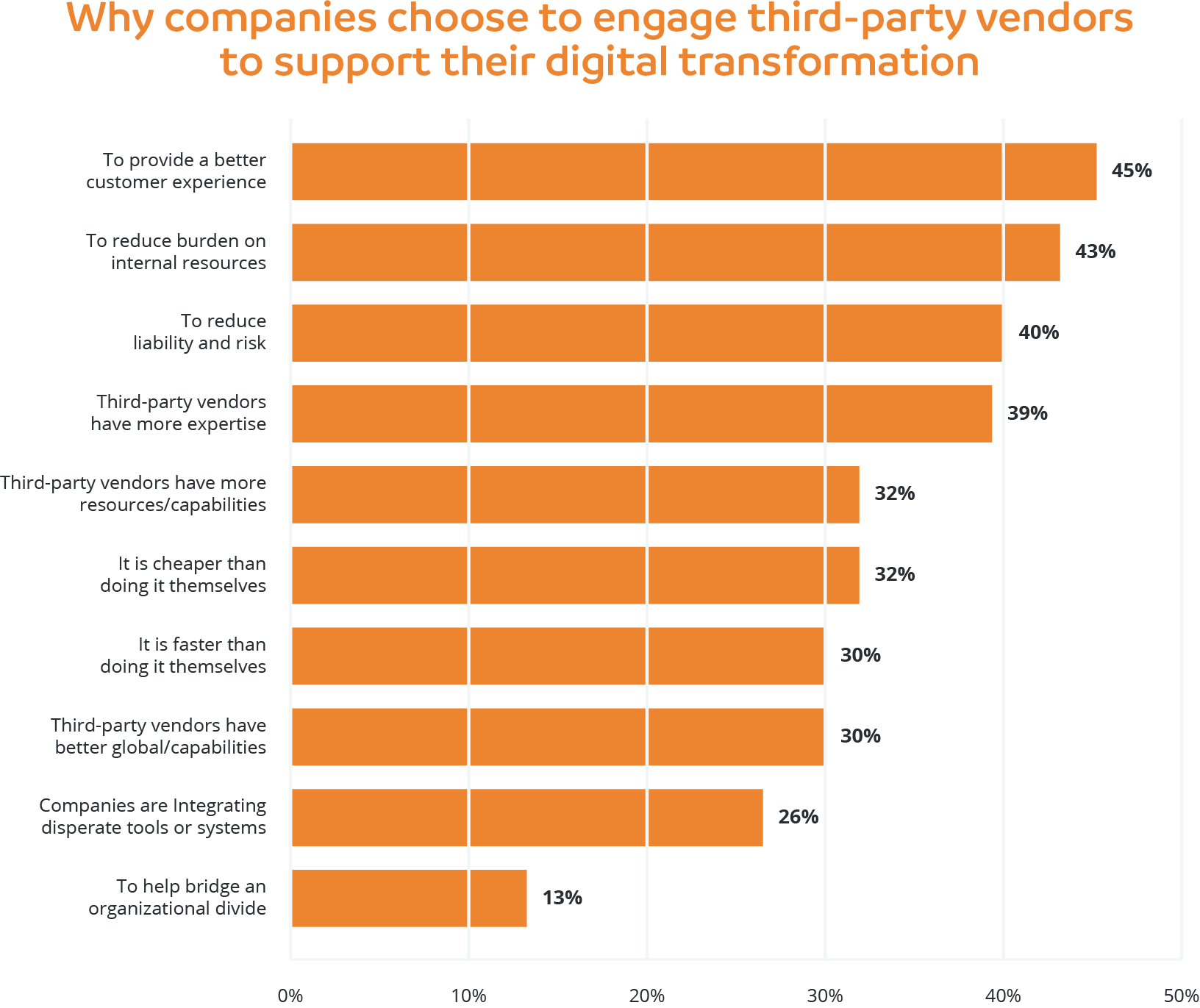
Source: An Entrepreneur’s Guide on Outsourcing Digital Transformation (appinventiv.com)
How does outsourcing support digital transformation?
Outsourcing can support digital transformation in two ways. Businesses can add specialist digital capabilities directly, such as software development, quality assurance, data management or technical support. They can also outsource selected operational functions to give internal teams more capacity to focus on transformation.
The right approach depends on where the constraint sits. An organization facing a technology skills gap may need additional digital specialists. One whose experienced employees are consumed by routine processes may gain more from moving appropriate operational work to an external team.
In both cases, outsourcing works best when it supports a clearly defined business outcome. Additional people alone will not resolve unclear priorities, fragmented processes or weak project ownership.
Organizations considering this approach should first understand how a dedicated offshore team works and where responsibility sits between the business and its outsourcing partner.
For technology-specific requirements, MicroSourcing’s guide to IT services outsourcing outlines common functions, including software development, database administration and systems support.
What are the benefits of outsourcing for digital transformation?
Outsourcing can help organizations address the practical constraints that slow transformation, from limited specialist skills to competing operational demands. The benefits depend on how the work is selected, transferred and managed.
-
Free up internal capacity for higher-value work
Outsourcing selected administrative, operational or repeatable processes can reduce the workload carried by internal teams. When responsibilities are clearly designed and managed, that additional capacity allows employees to spend more time on strategic, customer-facing or transformation-related work.
For example, transferring routine data entry or reporting preparation can give internal specialists more time to interpret information, improve processes and support implementation. The capacity released should be intentional. Businesses need to decide which priorities employees will focus on once work moves to an external team. -
Access specialist skills and wider talent pools
Digital initiatives may require skills that are difficult to recruit locally or are not available within the existing team. The World Economic Forum identifies AI and big data, networks and cybersecurity, and technological literacy as the three fastest-growing skill areas through 2030.[2]
Accessing talent beyond the local labor market can help organizations fill specific capability gaps. Depending on the initiative, that could mean adding developers, data specialists, software testers or technical support professionals. Businesses can explore offshore roles and teams to identify where external talent could address a defined capability or capacity gap. -
Reallocate resources toward transformation priorities
Different labor markets and delivery models can create employment and infrastructure cost efficiencies. For organizations pursuing digital transformation, the strategic question is how those savings will be used.
Potential priorities include technology investment, specialist capabilities, employee training and implementation support. However, the business case should account for the full cost of delivery, including onboarding, management time, systems access and transition work. Savings are most useful when they support a clear investment plan rather than being treated as the only measure of success. -
Keep internal teams focused on strategic priorities
Additional capacity becomes valuable when internal teams can use it to advance work that requires their business knowledge and decision-making authority. External teams can take responsibility for defined activities while internal leaders focus on setting priorities, aligning stakeholders, redesigning processes and supporting employees through change. This approach can help offshore teams complement the local workforce by creating more room for internal employees to apply their expertise.
-
Scale capacity as transformation needs change
Transformation programs often need different capabilities at different stages. Implementation may require additional development and testing resources, while later stages may need training, technical support or ongoing maintenance.
Outsourcing can provide another way to adjust capacity as those requirements evolve. Recruitment lead times, training needs and contractual terms still need to be built into the plan; staffing changes are not instantaneous.
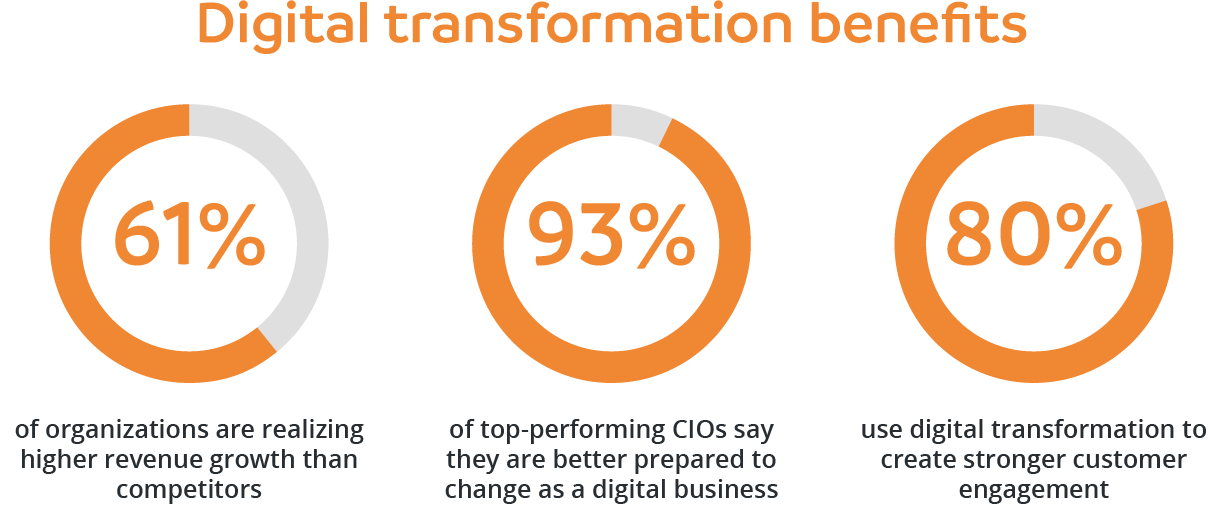
Source: Digital Transformation Strategies & Benefits (valuecoders.com)
How can businesses manage outsourcing risks during digital transformation?
Outsourcing introduces dependencies that need active management. Clear ownership, effective collaboration and appropriate security controls help businesses integrate external teams into transformation work.
-
Define ownership, accountability and governance
Before transferring work, establish who sets priorities, approves changes, manages performance and resolves issues. These responsibilities should be reflected in the operating model and relevant agreements.
Different outsourcing models distribute responsibility differently. A dedicated staffing arrangement may leave day-to-day management with the client, while a managed service may give the provider responsibility for delivering agreed outcomes. Performance measures should reflect the purpose of the outsourced work. Depending on the function, they could include accuracy, turnaround time, backlog reduction or progress against delivery milestones. -
Build effective collaboration across distributed teams
Assess communication styles, language requirements, working hours and management expectations before choosing a delivery location or provider.
Shared documentation, regular communication and clear escalation paths help internal and external colleagues work toward the same objectives. Teams also need access to the business context behind their tasks, including why a process is changing and how their work affects customers or other departments. Effective collaboration requires deliberate planning rather than an assumption that teams will naturally work in the same way. -
Protect data and manage third-party security risks
Assess a provider’s security controls, access management, infrastructure, relevant certifications and incident-response processes before sensitive work is transferred. Establish which systems and information each role needs and how access will be reviewed and removed.
Contracts and confidentiality provisions should sit alongside technical safeguards and ongoing oversight. Businesses also need to understand which privacy, contractual and industry requirements apply to the work. MicroSourcing’s guide to managing data security when outsourcing provides further considerations for evaluating access controls, safeguards and provider security practices.
Which roles can businesses outsource to support digital transformation?
The right roles to outsource depend on whether a business needs to build digital capability directly or free up internal capacity by moving other operational work to an external team.
Roles that can contribute directly to digital delivery include:
- Software developers: Build, maintain and integrate applications and systems.
- Software quality assurance specialists: Test applications and help identify defects before release.
- Data analysts and data management specialists: Prepare, organize and analyze information used in reporting and decision-making.
- Technical support specialists: Help employees or customers use systems and resolve technical issues.
For organizations that need additional technical capability, outsourcing software developers can supplement an existing development team. Other roles may support transformation indirectly by maintaining operational delivery and releasing internal capacity:
- Accountants and payroll specialists
- Customer service representatives
- Data entry specialists
- Recruitment and administrative support specialists
- Sales support specialists
- Content moderators and graphic designers
These roles do not automatically advance transformation. Their contribution depends on the work transferred, the capacity released and how that capacity is used.
Build the capacity to put digital transformation into practice
Digital transformation requires more than technology investment. Organizations also need the people, capacity and operating flexibility to implement change while keeping the rest of the business running effectively.
Outsourcing can play a practical role by adding specialist capabilities, taking pressure off internal functions or creating time for employees to focus on transformation priorities. Businesses should retain clear ownership of the outcomes they want to achieve and align external support with those priorities.
MicroSourcing helps organizations build dedicated teams across technology, operations and specialist business functions. Clients select their talent and lead day-to-day performance, while MicroSourcing supports recruitment, HR, facilities, IT and operational infrastructure. This gives businesses another way to build the workforce capacity needed to execute and sustain change.
FAQs
Can outsourcing and automation be used together?
Yes. Automation can handle suitable rules-based activities, while external employees manage exceptions, review outputs and complete work requiring judgment. Define the process first so the technology and team have clear responsibilities.
How can businesses preserve knowledge when work moves to an external team?
Document workflows, decision rules, exceptions and system dependencies before the handover. Use shadowing, supervised practice and shared knowledge resources, and retain internal process owners who can maintain business context.
Who should own intellectual property created by an outsourced team?
Ownership and usage rights should be explicitly addressed in the relevant agreements. Clarify the treatment of custom code, documentation, designs, preexisting materials and third-party components before work begins.
When is outsourcing unlikely to solve a transformation problem?
When the underlying issue is unclear strategy, weak sponsorship or an undefined process, adding external capacity may leave the problem unresolved. First establish the intended business outcome and determine whether skills or workload are the actual constraint.
References:
[1] IDC. “Navigating Digital Transformation Amid Economic Uncertainty.” May 27, 2025.
[2] World Economic Forum. The Future of Jobs Report 2025: Key Findings. January 7, 2025.