.svg "header-logo")


The objective is not simply to reduce spending, but to use specialized support more efficiently without transferring clinical accountability or compromising service quality.
Healthcare organizations can outsource suitable non-clinical functions such as administration, medical billing and coding, transcription, data management and customer service. The model works best when outsourced professionals operate as an integrated extension of the organization, with clear processes, performance measures, security controls and accountability.
This guide explains how healthcare cost management works, where outsourcing can deliver operational value and which healthcare support functions are commonly outsourced.
Content Guide
- What is healthcare cost management?
- What are the benefits of outsourcing healthcare support?
- Which healthcare support services can be outsourced?
- When should healthcare organizations consider outsourcing?
What is healthcare cost management?
Healthcare cost management is when a hospital or healthcare provider aims to reduce spending without negatively impacting the patient and their bottom line. The strategy is an option for health organizations of various sizes and services and can involve optimizing staffing, adjusting schedules, enhancing patient flow and utilizing innovative digital tools. Crucially, reducing unnecessary costs can help providers deliver more quality care to more patients.
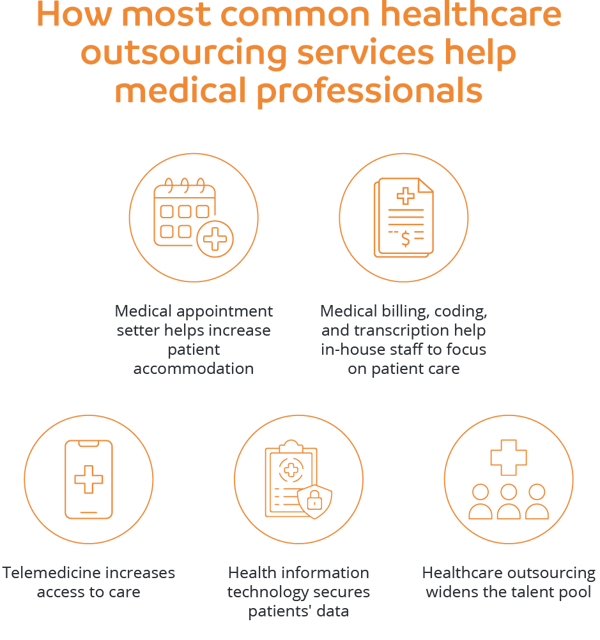
Source: Outsourcing Trends in the Healthcare Industry - The New Workforce
What are the benefits of outsourcing healthcare support?
Healthcare outsourcing can support cost management in five ways: lowering administrative and revenue-cycle costs, adding operational capacity, scaling resources as demand changes, strengthening billing and coding controls, and returning more clinician time to patient-facing work.
- Lower administrative and revenue-cycle costs: healthcare organizations face significant costs when claims are denied or administrative processes require repeated manual intervention. McKinsey reported that 15% of initial healthcare claims were denied by the end of 2023, up from 9% in 2016, while prior authorization activities cost care-delivery organizations an average of $6 to $11 per claim.[1] Outsourcing selected revenue-cycle and administrative functions can provide dedicated capacity for claims support, billing, coding and follow-up without requiring every capability to be expanded internally. Any savings should be assessed alongside accuracy, collections, security and service quality.
- Additional operational capacity: healthcare organizations need enough administrative and operational support to keep pace with growing service demand. The U.S. Bureau of Labor Statistics projects approximately 1.9 million openings across healthcare occupations each year between 2025 and 2035.[2] Offshore teams do not replace licensed clinicians or roles that require local patient care. Instead, they can support suitable non-clinical work, helping internal employees and clinicians concentrate on responsibilities that require their qualifications, judgment or physical presence.
- Scalable support: healthcare workloads can change because of enrollment periods, seasonal demand, acquisitions, backlogs or changes in patient volumes. An outsourcing provider can help add or adjust suitable support roles without requiring the healthcare organization to rebuild its internal structure each time demand changes. Scaling should still follow an agreed workforce plan, implementation timeline and quality-control process.
- Stronger billing and coding controls: accurate medical billing and coding depend on trained professionals, documented processes, current coding knowledge and consistent quality assurance. A dedicated support team can help healthcare organizations process records, identify incomplete information and monitor work against agreed accuracy standards. Performance should be measured through indicators such as clean-claim rates, denial rates, coding accuracy and rework volumes.
- More time for patient-facing work: transferring suitable administrative and repetitive tasks to a support team can reduce the amount of non-clinical work handled by doctors, nurses and allied health professionals. This allows clinical employees to direct more of their working time toward patients and responsibilities that require clinical expertise. The healthcare organization should retain responsibility for clinical decisions, patient safety and service standards.
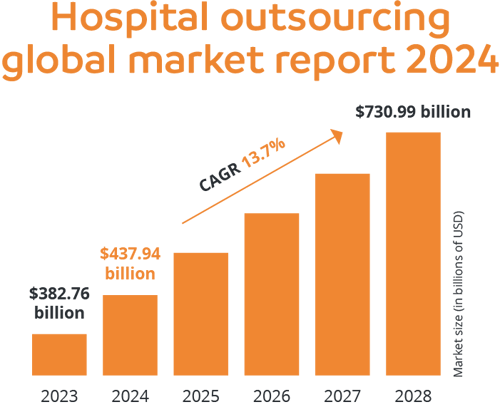
Source: Hospital Outsourcing Market Report 2024 - Hospital Outsourcing Market Size And Outlook By 2033
Which healthcare support services can be outsourced?
Healthcare organizations commonly outsource five support areas: administration, medical transcription, data management, customer service and data entry. The appropriate scope depends on the organization’s systems, regulatory obligations, internal capabilities and the sensitivity of the information involved.
- Administration: modern technology means it has never been easy for hard-working talent to provide administrative support from remote locations. Outsourcing providers can handle tasks including appointment scheduling, insurance coordination and human resources.
- Medical transcription: clinical staff need to maintain accurate records but transcribing medical notes steals precious time that they would rather spend with patients. Outsourcing medical transcription is a smarter way of tackling this task and eases the load on doctors, nurses and allied health staff.
- Data management: data is king in the modern world and nowhere more than in the health sector given its ability to deliver valuable insights into patients and trends. Offshore specialists can provide the expertise needed to manage and analyze data and support better decision-making.
- Customer service: a little understanding goes a long way in healthcare, which is why many hospitals are turning to outsourcing providers for customer service. The combination of reduced labor costs, leading technology and access to hard-working, empathetic talent is allowing health services to provide more patients with more support more of the time.
- Data entry: hospitals and health services deal with endless data, be it medical claims, patient bills or test results. Quality outsourcing providers offer an ideal solution for entering and storing data in the cloud, with streamlined processes and an unwavering commitment to accuracy.
When should healthcare organizations consider outsourcing?
Healthcare organizations should consider outsourcing when administrative demand, recruitment pressure, revenue-cycle workloads or changing service volumes are limiting internal capacity. The strongest opportunities are usually clearly defined, repeatable support functions that can be governed through documented workflows, access controls and measurable service standards.
The goal is not to outsource responsibility for care. It is to build an integrated support team that helps clinicians and internal specialists spend more time where their expertise has the greatest value. A managed outsourcing partner can provide recruitment, facilities, technology and operational support, while the healthcare organization retains control of clinical decisions, compliance requirements and performance expectations.
Reference:
[1] McKinsey & Company, “Three ways to ease the pressure on health system revenue cycles,” September 10, 2024. https://www.mckinsey.com/industries/healthcare/our-insights/healthcare-blog/three-ways-to-ease-the-pressure-on-health-system-revenue-cycles
[2] U.S. Bureau of Labor Statistics, “Healthcare Occupations,” Occupational Outlook Handbook, updated September 2026. https://www.bls.gov/ooh/healthcare/home.htm
[3] U.S. Department of Health and Human Services, “Direct Liability of Business Associates.” https://www.hhs.gov/hipaa/for-professionals/privacy/guidance/business-associates/factsheet/index.html
FAQs
Which healthcare functions should remain in-house?
Clinical decision-making, patient-safety accountability, core leadership and work that requires locally licensed professionals or physical patient contact will generally remain in-house. Each organization should assess functions individually based on clinical risk, regulation, data access and the level of judgment involved.
Can a HIPAA-covered healthcare organization use an outsourcing provider?
Yes, but an outsourcing provider that creates, receives, maintains or transmits protected health information may be considered a business associate. The parties generally need an appropriate business associate agreement, and the provider must comply with applicable privacy, security and breach-notification obligations.[3]
How should healthcare organizations calculate outsourcing savings?
Savings should be measured against the total current cost of delivering the function, not salary differences alone. The comparison should consider recruitment, employee benefits, facilities, technology, management, overtime, rework, vacancy periods and the cost of service backlogs.
What should a healthcare outsourcing implementation plan include?
The plan should define the scope of work, responsibilities, systems access, security controls, training, knowledge transfer, quality standards, performance measures and escalation procedures. A staged transition can help identify workflow or access issues before the team assumes full responsibility.
How can a healthcare organization retain control of outsourced work?
The organization should retain ownership of policies, clinical requirements, access decisions and performance expectations. Regular reporting, quality reviews, documented escalation paths and direct communication between internal and outsourced leaders help maintain visibility and accountability.
Can smaller healthcare practices use outsourcing?
Yes. Smaller practices can begin with a limited function or a small number of roles, such as appointment scheduling, billing support or transcription. The scope should be large enough to justify implementation and management requirements while remaining proportionate to the practice’s needs.