.svg "header-logo")


Retail has never stood still, but the pace and breadth of change are accelerating.
Consumers are reassessing what represents genuine value, artificial intelligence is reshaping how products are discovered and purchased, and retailers are being asked to deliver faster, more personalized experiences while managing increasingly complex operations. Despite ongoing economic uncertainty, retail leaders have reasons to be optimistic. Deloitte’s 2026 Global Retail Industry Outlook, based on a survey of 330 retail executives, found that:
- 96% expect industry revenues to grow
- 81% anticipate margin expansion in the year ahead [1].
In the United States, the National Retail Federation has forecast retail sales growth of 4.4% in 2026, taking annual sales to $5.6 trillion[2]. The opportunity is real but growth is becoming more demanding. Retailers must respond to value-conscious consumers without relying solely on discounts. At the same time, AI adoption, supply-chain transformation and rising operating costs are putting greater pressure on teams, technology and budgets. Deloitte’s research found that almost all surveyed retail executives expect higher costs in 2026, even as businesses pursue ambitious growth and margin targets.[1]
Traditional cost-cutting alone is unlikely to address these competing demands.
Retailers need operating models that allow them to access specialist skills, expand capacity and improve execution without adding unnecessary complexity or committing to a large fixed-cost base.
This is where outsourcing can play an important role.
By partnering with an experienced outsourcing provider, retail and eCommerce businesses can build dedicated teams to support functions such as customer service, digital merchandising, finance, administration, technology, marketing and supply-chain operations. These teams can provide additional capacity during periods of growth or fluctuating demand while giving internal employees more time to focus on strategy, customers and the capabilities that differentiate the brand.
Modern outsourcing is more than moving tasks to a lower-cost location. When implemented deliberately, it can become a strategic capability that helps retailers strengthen service levels, address talent constraints and maintain performance as operating conditions change. Research by The Shared Services & Outsourcing Network (SSON) similarly positions outsourcing as a way to respond to margin pressure, limited internal capacity and rising customer expectations, not simply as a labor-replacement exercise.
Content Guide
- What is outsourcing in retail?
- What retail or eCommerce tasks can be outsourced?
- What are the benefits of outsourcing in retail?
- How to make retail outsourcing work
- Turn outsourcing into a retail growth capability
What is outsourcing in retail?
Outsourcing in retail is the process of engaging an external provider to perform specific functions that would otherwise be handled entirely by an in-house team. Depending on the retailer’s requirements, this may involve one specialist, a dedicated offshore team or a managed service responsible for an agreed area of operations.
An outsourced team can support functions such as customer service, eCommerce operations, finance, marketing, technology, administration and supply-chain support. Rather than operating separately from the business, a well-designed team works within the retailer’s existing systems, processes and performance framework, becoming an extension of its onshore operation.
The right arrangement depends on three factors:
- The nature and complexity of the work
- The outcomes the retailer wants to achieve
- The level of operational control it wants to retain
For example, a dedicated offshore team may suit a retailer that wants to direct daily activities and integrate employees closely with its internal departments. A managed-service arrangement may be more appropriate when the provider is expected to oversee an end-to-end process and deliver against defined service levels or business outcomes.
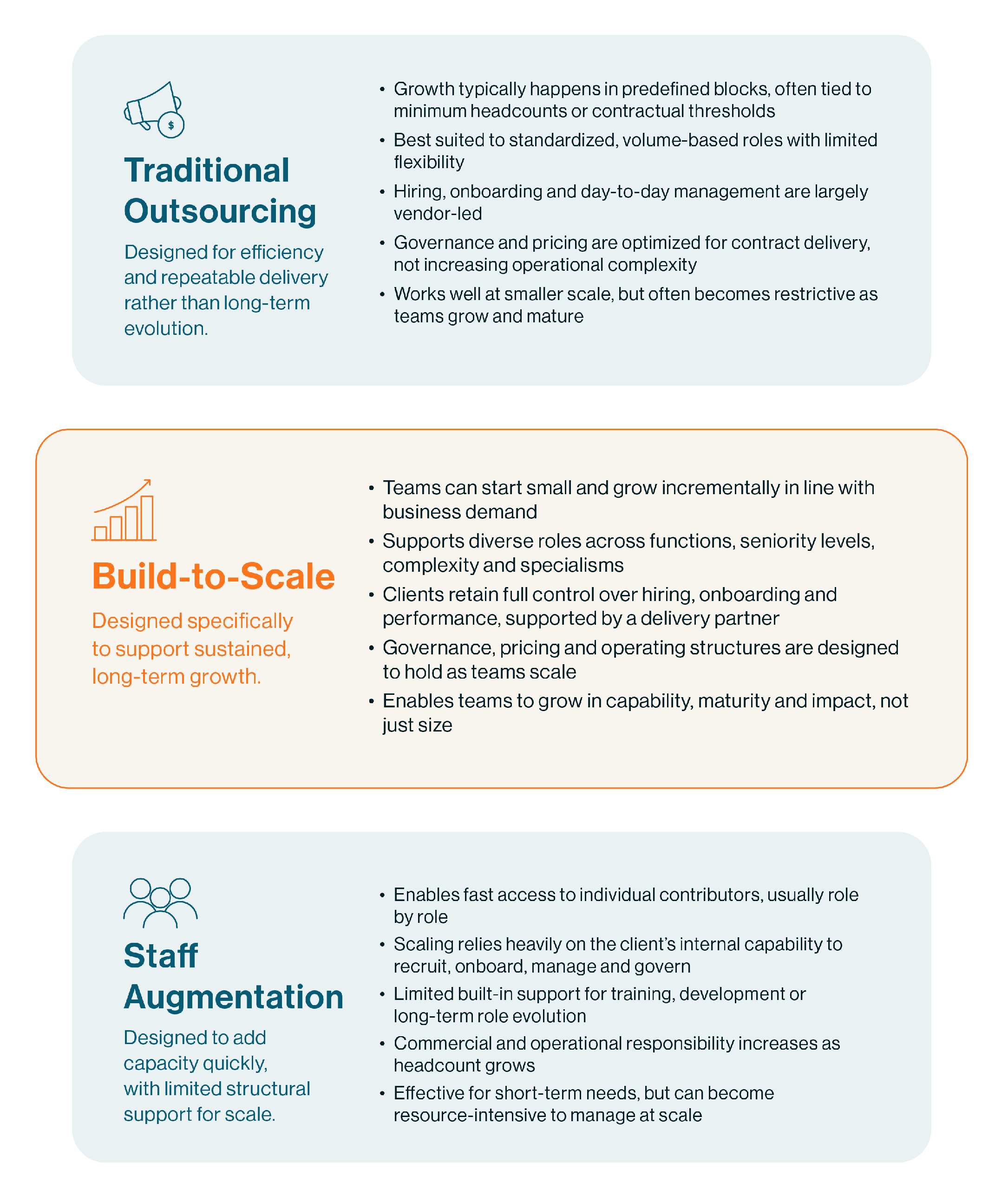
Whatever model is selected, successful retail outsourcing requires more than transferring a list of tasks.
Retailers need to establish clear responsibilities, document how work should be completed and agree on how internal and external teams will communicate, manage exceptions and resolve issues. Processes that rely heavily on unwritten knowledge should be documented before they are transitioned so the new team can deliver consistently.
Measures of success should also be defined before the team begins operating. Depending on the function, these may include:
- Customer response and resolution times
- Order accuracy and processing turnaround
- Backlog levels
- Customer satisfaction
- First-contact resolution
- Website or technical-support resolution times
- Invoice-processing accuracy
- Cost per transaction
These measures ensure that the partnership is assessed according to the results it delivers, rather than simply the number of people completing the work.
It is also important to recognize that outsourcing changes who performs the work, but it does not remove the retailer’s accountability. Responsibility for customer experience, data protection, regulatory compliance and business outcomes remains with the organization, even when aspects of execution are handled by an external provider.
This makes clear governance essential. Retailers should maintain visibility over performance and risk through documented control ownership, agreed reporting processes, audit trails and clear escalation procedures. When these foundations are in place, outsourcing can give retail and eCommerce businesses access to additional capacity and specialist expertise without requiring every capability to be built internally. It can also free internal employees to spend more time on strategic priorities, customer relationships and the products, experiences and capabilities that differentiate the brand.
What retail or eCommerce tasks can be outsourced?
The best tasks to outsource are usually those that are repeatable, process-driven or difficult to resource consistently in-house. Retailers can also use offshore teams to access specialist skills, provided responsibilities and performance expectations are clearly defined.
Common retail and eCommerce outsourcing opportunities include:
Customer Service
For retailers experiencing fluctuating demand, outsourcing can provide additional coverage during promotions, product launches and peak trading periods without requiring the same level of permanent in-house capacity.
-
Order tracking and delivery questions
-
Returns, exchanges and refunds
-
Product and warranty support
-
Loyalty-program administration
-
Complaint handling and escalation
-
After-hours or seasonal support.
eCommerce & Digital Merchandising
These teams help keep product information accurate, consistent and up to date across websites, applications and third-party marketplaces.
-
Product uploads and catalog maintenance
-
Product descriptions and content enrichment
-
Pricing and promotion updates
-
Marketplace administration
-
Order processing
-
Inventory-data updates
-
Returns administration
-
Website and sales reporting.
Marketing & Creative Services
AI can accelerate parts of this work, but human oversight remains important for protecting brand voice, checking product accuracy and adapting content for different audiences.
-
Campaign production
-
Search engine optimization
-
Email and CRM communications
-
Social-media management
-
Graphic design and video editing
-
Product imagery and creative adaptation
-
Marketing analytics and reporting
Technology & Data Support
Highly strategic work involving proprietary products, intellectual property or core AI capabilities may still need to remain closely owned by the retailer. A hybrid model can allow the business to outsource repeatable technical execution while retaining control of the capabilities that differentiate it.
-
Website and application development
-
Software testing and quality assurance
-
eCommerce platform support
-
Help-desk and technical support
-
Systems and marketplace integrations
-
Data cleansing and reporting
-
Workflow automation
-
Cybersecurity and access-management support
Finance, Administration & Supply-Chain Support
Current research shows that outsourcing is expanding beyond basic transactional work into areas such as customer experience, IT, data management, finance and procurement or supply chain [3].
-
Accounts payable and receivable
-
Invoice processing and reconciliation
-
Bookkeeping and financial reporting
-
Data entry and document processing
-
HR and payroll administration
-
Purchase-order processing
-
Supplier administration
-
Inventory and logistics reporting
-
Shipping coordination
What are the benefits of outsourcing in retail?
Cost remains an important consideration, but the value of outsourcing has evolved. For today’s retailers, the strongest models can also provide specialist capability, scalable capacity, more consistent execution and measurable performance.
-
Reduced employment and operating costs: building an offshore team can reduce employment costs by giving retailers access to skilled professionals in global talent markets. The level of savings will vary according to the role, experience required and operating model, but current salary comparisons show substantial potential savings across retail-relevant functions such as customer service, marketing, IT, finance and administration.
- Access to specialist talent: retailers may struggle to recruit or retain professionals with experience in areas such as eCommerce platforms, data, digital marketing, finance and customer experience. Outsourcing provides access to broader talent pools and can accelerate recruitment in areas where local skills are scarce or expensive.
- Scalable capacity: retail demand can change quickly during promotions, product launches, holiday periods and periods of rapid growth. An offshore team can provide additional capacity without requiring every role to be added permanently to the retailer’s local workforce. Current outsourcing research describes this as closing the capacity gap without slowing growth, absorbing transactional workloads while protecting the work that requires internal attention.
- Improved consistency and process discipline: quality outsourcing providers bring structured workflows, documentation, quality-assurance processes and escalation procedures. These foundations can help retailers reduce reliance on informal knowledge and improve consistency across teams, channels and locations. When processes are clearly defined and governed, the potential outcomes include shorter cycle times, improved first-time accuracy, fewer escalations and less rework.
- Measurable performance: modern outsourcing should be measured by more than headcount or the number of tasks completed. Retailers can link team performance to outcomes such as customer response and resolution times, first-contact resolution, customer satisfaction, cost per transaction and more. This shifts the focus of outsourcing from providing additional labor to improving the operational KPIs that matter to the business.
- Greater operational resilience: outsourcing can diversify where work is performed, reducing dependence on one location or a small group of employees. A distributed delivery model can provide continuity during demand spikes, local disruption or recruitment challenges while helping retailers maintain service across different time zones.
- More time for strategic priorities: by moving suitable repeatable and process-driven work to an external team, internal employees can concentrate on activities that differentiate the retailer, including customer strategy, merchandising decisions, brand development, innovation and growth.

How to make retail outsourcing work
Successful outsourcing starts with a clearly defined business problem, not a general desire to reduce headcount. Retailers should identify where capacity, skills or process constraints are affecting service, cost or growth. From there, five foundations matter:
Choose the right scope
Prioritize repeatable, well-defined work where an external team can add capacity or expertise without weakening strategic ownership.
Match the model to the work
The right balance of control, flexibility and provider responsibility will differ across customer service, eCommerce, technology and back-office functions.
Document the process
Workflows, exceptions, decision rights and escalation procedures should be clear before transition. Outsourcing an inconsistent process may simply move the problem elsewhere.
Set measurable KPIs
Agree on outcomes such as response times, order accuracy, backlog reduction, customer satisfaction and cost per transaction.
Establish strong governance
Regular reporting, clear communication and shared accountability help the partnership evolve as the retailer’s needs change.
Outsourcing delivers the greatest value when it is applied precisely, supported by clear processes and measured against business outcomes.
Turn outsourcing into a retail growth capability
Retail outsourcing delivers the greatest value when it is designed around a clear operational need. With the right scope, processes and performance measures in place, an offshore team can help retailers access specialist talent, scale with demand and improve execution across customer service, eCommerce, technology and back-office operations.
References
[1] Deloitte, 2026 Global Retail Industry Outlook