.svg "header-logo")


For decades, outsourcing was treated as a relatively straightforward operating decision. Organizations evaluated costs, selected a provider and transferred defined work into a vendor-led model designed for efficiency and scale.
Today, that simplicity has disappeared.
As Global Business Services (GBS) has expanded in scope and maturity, outsourcing has evolved from a cost-management tool into a strategic mechanism capable of supporting multiple enterprise outcomes, including service excellence, digitalization and operational effectiveness.
.png?width=1459&height=489&name=MS_BLOG_PROMO_Why%20Outsourcing%20Decisions%20Are%20Getting%20Harder%2c%20Not%20Easier-01%20(1).png)
Each regulatory shift, whether related to eligibility clarification, subsidy recalculation, or policy interpretation, creates ripple effects across servicing operations. Member inquiries increase. Enrollment workflows become more complex. Documentation requirements expand.
What once represented a single decision now requires leaders to navigate an increasingly diverse landscape of delivery models, partnerships and governance structures. The result is a paradox.
Organizations have more outsourcing options than ever before, yet the process of selecting the right model has become significantly more complex.
Content Guide
The rise of hybrid outsourcing
One of the most important shifts reshaping outsourcing is the rapid adoption of hybrid delivery models.
Rather than committing to a single outsourcing structure, many organizations now blend multiple approaches within the same operating framework. Work is distributed based on complexity, strategic importance and operational requirements. Standardized processes may be delivered through managed services, while specialized capabilities or rapidly evolving workstreams are supported through staff augmentation or more traditional outsourcing arrangements.
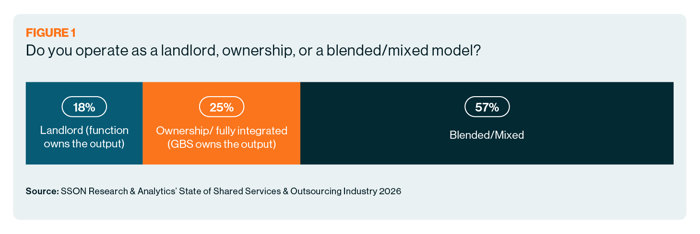
This blended approach has quickly become the norm with 57% of organizations now operating using hybrid or mixed service delivery models.
 Hybrid outsourcing reflects a logical response to modern enterprise demands. Businesses must simultaneously control costs, access specialized skills, maintain governance and adapt to rapidly changing priorities.
No single model can deliver all of these outcomes effectively.
Combining models allows organizations to match the right delivery approach to the right type of work. However, the flexibility that hybrid models introduce also creates new layers of operational complexity.
When ownership and governance become fragmented
Traditional outsourcing models were relatively simple from a governance perspective. A vendor owned defined processes, managed delivery and was measured against service-level agreements. Client engagement largely focused on contract oversight and performance management.
Hybrid environments rarely operate with that level of clarity.
When multiple outsourcing models coexist, responsibilities become distributed across different structures. Some workstreams remain internally governed, others are vendor-led and still others operate through a dedicated offshore team that integrate directly into internal operations.
Capabilities, ownership and governance responsibilities can vary significantly depending on the model being used.
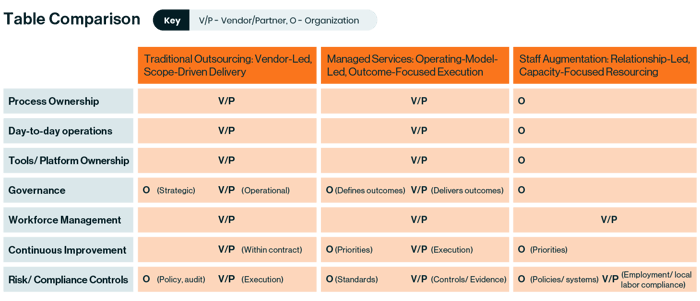 This fragmentation introduces new operational questions.
-
Who ultimately owns the process when execution spans internal teams and multiple external partners?
-
How are decisions escalated when accountability crosses organizational boundaries?
-
How should governance adapt when different models operate under different assumptions about ownership, control and outcomes?
These questions do not have universally accepted answers. Instead, organizations often find themselves balancing trade-offs between simplicity and customization, attempting to design governance structures capable of coordinating increasingly diverse delivery environments.
Hybrid models are often assembled, not designed
Another factor complicating outsourcing decisions is that hybrid operating models are not always created through deliberate design.
SSON Research & Analytics data shows that many organizations adopt blended or landlord-style models primarily because of internal structural realities or cultural constraints, rather than through a clearly articulated sourcing strategy.
.png?width=700&height=427&name=MS_BLOG_PROMO_Why%20Outsourcing%20Decisions%20Are%20Getting%20Harder%2c%20Not%20Easier-04%20(1).png) In other cases, hybrid approaches emerge as organizations attempt to scale capabilities in areas where deep internal expertise does not exist.
In other cases, hybrid approaches emerge as organizations attempt to scale capabilities in areas where deep internal expertise does not exist.
In practice, this means hybrid models often evolve incrementally. New delivery approaches are layered onto existing structures to solve immediate problems, address skill shortages or accelerate growth. Over time, the outsourcing ecosystem expands into a complex combination of vendors, talent models and governance structures.
While this flexibility enables organizations to move quickly, it can also create fragmented operating environments where ownership is unclear, processes vary across teams and tools are not fully integrated.
The complexity introduced by hybrid delivery does not typically appear during the initial outsourcing decision. Instead, it tends to surface later, as organizations attempt to coordinate multiple delivery approaches within a single operating system.
When more choice creates decision paralysis
The growth of outsourcing models has ultimately produced a market that is more flexible but also more difficult to navigate.
Traditional outsourcing, managed services and staff augmentation all offer distinct advantages depending on the context. Hybrid combinations add even more potential configurations. While this diversity expands the possibilities available to organizations, it also introduces uncertainty when evaluating which model, or combination of models, best aligns with strategic priorities.
This ambiguity often leads to decision paralysis. As outsourcing options multiply, differentiation between models can become less clear, making it harder for leaders to determine which structure will deliver the outcomes they need.
In earlier outsourcing eras, decisions were constrained by limited choices. Today, the opposite problem exists. Every model appears viable, each offering different benefits around flexibility, control, scalability or operational ownership. Determining the optimal balance between these factors requires significantly more analysis, alignment and long-term planning.
Rethinking outsourcing: from model selection to execution readiness
Outsourcing hasn’t become harder because there are too many models. It has become harder because those models now need to work together.
Hybrid delivery has shifted outsourcing from a single decision into a system design challenge. Selecting the right model is no longer enough. Without clear governance, aligned ownership and consistent ways of working, complexity compounds quickly and slows execution.
The most successful organizations are moving beyond choosing a single outsourcing model. To achieve optimal results, they are instead designing a hybrid delivery model where multiple approaches operate seamlessly as a unified whole.