.svg "header-logo")


Outsourcing decisions are rarely revisited once contracts are signed.
The focus shifts quickly from design to delivery, with the expectation that the chosen model will begin generating value within a defined timeframe. When outcomes fall short, the instinct is often to question the provider, the commercial structure or the model itself.
However, a different pattern is emerging across Global Business Services (GBS) environments.
Many outsourcing challenges are not rooted in flawed model selection but in an organization’s ability to operationalize that model once it is in motion.
The issue is less visible during procurement and far more apparent during execution. This creates a hidden risk. Outsourcing strategies are increasingly evaluated on their structural design, yet their success is determined by how effectively that design translates into day-to-day operations across distributed teams, systems and governance layers.
Content Guide
- Execution failure is rarely immediate, but it is predictable
- Readiness gaps are embedded before outsourcing begins
- Operational discipline determines whether scale is achievable
- Partnerships succeed when execution is shared, not transferred
- Rethinking outsourcing: from model selection to execution readiness
Execution failure is rarely immediate, but it is predictable
Most outsourcing initiatives do not fail at the point of transition. Early stages often appear stable, with service levels met and delivery progressing according to plan. It is only over time that underlying weaknesses begin to surface.
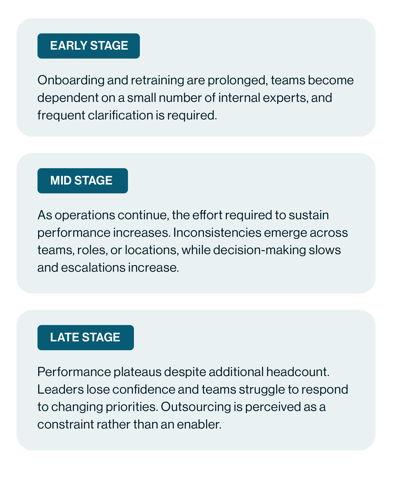 The early stage: the first signals are subtle. Onboarding cycles extend beyond expectations, requiring more intensive support from internal teams. External delivery begins to rely disproportionately on a small number of experienced employees who act as informal knowledge anchors. Activities that should be repeatable require ongoing clarification, indicating that processes are not as transferable as assumed.
The mid stage: as operations continue, the effort required to maintain performance increases. Teams begin to diverge in how work is executed across locations or partners. Decision-making slows as questions escalate through unclear governance pathways. What initially appeared to be a stable delivery model starts to absorb more managerial attention.
The late stage: by the later stages, these patterns become structural constraints. Additional headcount fails to improve outcomes, responsiveness declines, and leaders begin to perceive outsourcing as limiting rather than enabling change. These outcomes are not sudden disruptions. They are the result of predictable execution gaps that were present from the outset.
Readiness gaps are embedded before outsourcing begins
A critical challenge is that execution readiness is often assumed rather than assessed. Organizations may believe their processes are standardized, their systems integrated and their governance structures well understood, until those assumptions are tested in an outsourced environment.
In practice, many operational environments rely on informal ways of working. Processes may vary subtly across teams, documentation may be incomplete or outdated, and tools may not be consistently used across functions or regions. These inconsistencies are manageable within co-located teams but become amplified when work is distributed across external partners.
The data reflects how widespread this issue is.
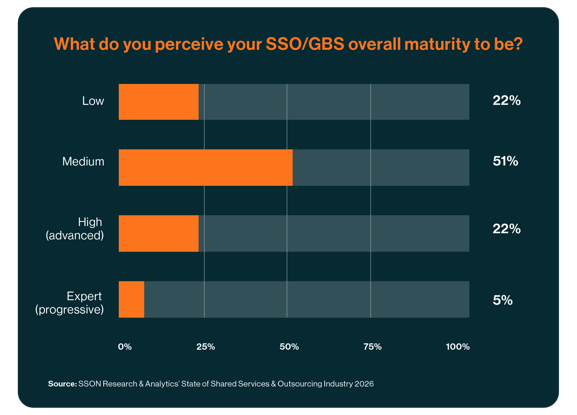 At the same time, just 15% report high or expert automation maturity, indicating that many environments still lack the standardized, system-enabled ways of working required for consistent execution.
This matters because outsourcing does not simplify operations. It exposes them.
When work moves across organizational boundaries, the absence of standardization, clarity and shared systems becomes immediately visible.
Execution readiness, therefore, is not a downstream concern but a prerequisite.
Operational discipline determines whether scale is achievable
Outsourcing is often positioned as a mechanism for scale. Yet scale is not achieved through additional capacity alone. It depends on whether work can be executed consistently, predictably and independently of individual knowledge holders.
This is where operational discipline becomes critical. Standardized processes enable work to flow across teams without constant interpretation. Shared tools create visibility, allowing internal and external stakeholders to operate within the same system of record. Clear governance ensures that decisions are made quickly, even when multiple parties are involved.
Without these elements, scaling outsourcing efforts introduces friction rather than efficiency. Each new team, location or partner increases variability instead of absorbing demand. Over time, the organization becomes more complex to manage, not more capable. The scale of modern outsourcing amplifies this challenge.
In such contexts, even small inconsistencies in processes or tools can compound quickly across regions. Here, outsourcing success is less about simply adding headcount and more about building an operating environment where a dedicated offshore team can perform effectively.
Partnerships succeed when execution is shared, not transferred
Another misconception in outsourcing is that execution can be handed over entirely to a partner. While responsibility for delivery may shift, accountability for outcomes remains shared.
High-performing outsourcing relationships are built on this principle. Partners operate as extensions of the organization, not as isolated service providers. This requires clarity around decision rights, ownership and expected outcomes from the outset.
When these elements are not defined, friction emerges quickly. Questions around who owns process improvements, who resolves exceptions or how priorities are adjusted can slow delivery and create misalignment. Over time, this erodes both performance and trust.
Strong partnerships, by contrast, are structured around coordinated execution. Internal teams and external partners operate within aligned processes, shared tools and common governance frameworks. This alignment reduces ambiguity and enables faster, more consistent delivery across distributed environments.
The implication is clear. Outsourcing does not remove the need for operational ownership. It increases the need for it.
Rethinking outsourcing: from model selection to execution readiness
The hidden risk in modern outsourcing is not that organizations choose the wrong model. It is that they overestimate their readiness to execute the model they choose.
Hybrid delivery has shifted outsourcing from a single decision into a system design challenge. Selecting the right model is no longer enough. Without clear governance, aligned ownership and consistent ways of working, complexity compounds quickly and slows execution.
For enterprise and GBS leaders, this requires a shift in focus. Evaluating outsourcing options remains important, but equal weight must be given to assessing whether the organization can sustain execution at scale.