Artificial intelligence is advancing faster than many organizations can adapt. While businesses are investing in automation and exploring new ways to improve productivity, the transition is raising a more fundamental question: Are their people keeping pace?
The numbers suggest there is still considerable ground to cover.
A survey of member organizations by the IT and Business Process Association of the Philippines (IBPAP) found that 24% had already reported changes in job roles due to AI adoption, while 26% identified significant reskilling requirements. The findings point to a workforce undergoing structural change, one that requires businesses to rethink not only the technology they use but also the skills and capabilities they develop.
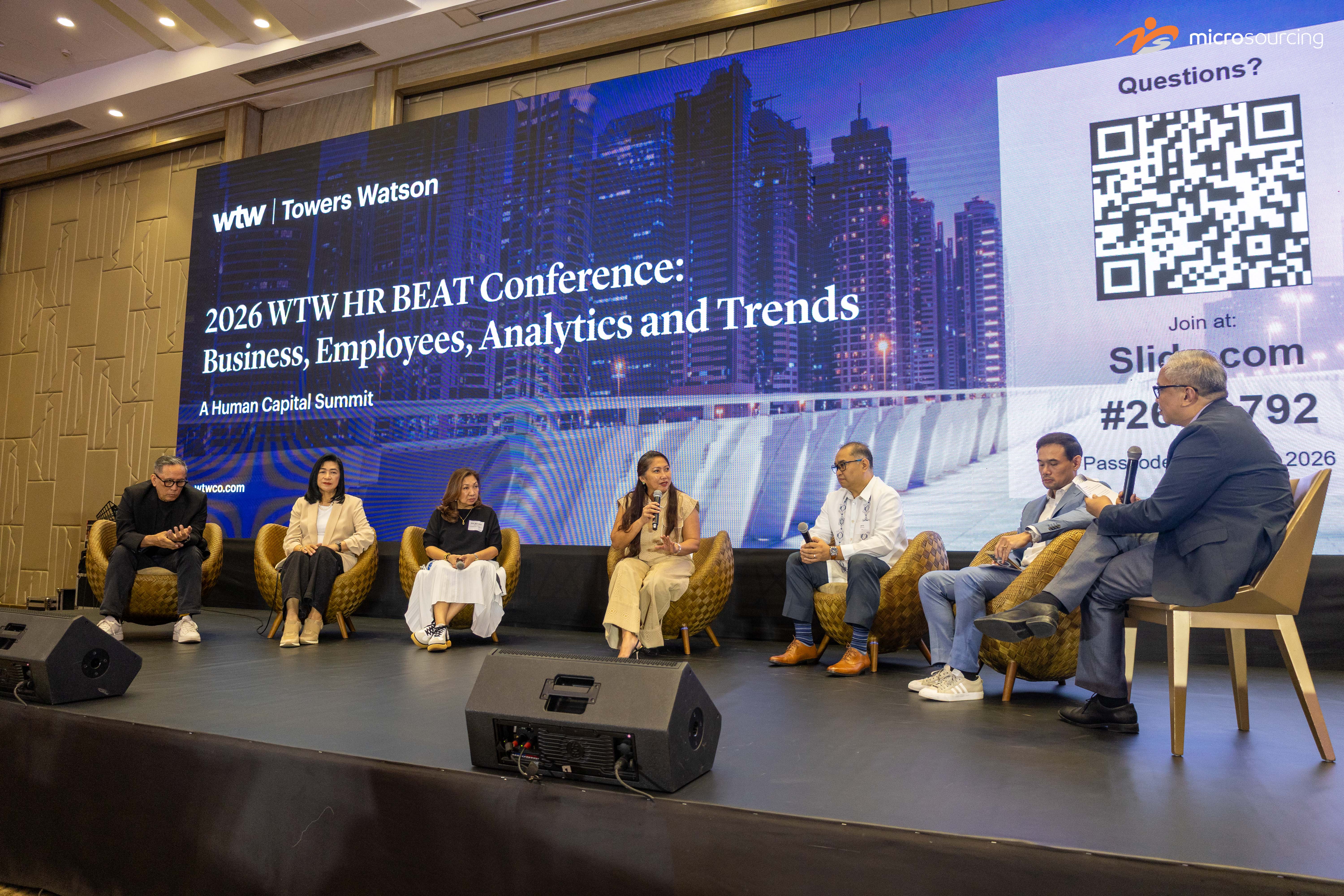
 Haidee Enriquez (fourth from left) shares MicroSourcing’s people-first approach to AI adoption and workforce transformation during the 2026 WTW HR BEAT Conference in Bonifacio Global City.
For MicroSourcing, this is where the conversation about AI needs to begin, with people.
MicroSourcing brought this perspective to the 2026 WTW HR BEAT (Business, Employees, Analytics & Trends) Conference: A Human Capital Summit - Philippines, held on November 11 at Marquis Events Place in Bonifacio Global City. MicroSourcing Chief Executive Officer Haidee Enriquez joined fellow industry leaders as a panelist in the session, Navigating Work Transformation: Reshaping Work, Enabling Productivity, Rewarding Impact, where discussions focused on the changing relationship between technology, talent, and business performance.
Enriquez emphasized that organizations must move beyond traditional definitions of productivity, particularly in an industry where efficiency and scale have long been central to competitiveness.
For the Philippine Customer Experience (CX) industry, the distinction is significant. The country's competitive advantage has traditionally rested on its ability to provide skilled talent at scale and deliver services efficiently. But as AI takes on more repetitive and transactional work, measuring performance through headcount, hours worked, and transaction volumes alone will become increasingly inadequate.
The next measure of competitiveness will be the value employees create, and that includes their ability to solve complex problems, exercise judgment, strengthen customer relationships, and contribute specialized expertise.
This shift is also reflected in IBPAP's 2028 industry outlook, which emphasizes a move from capacity to capability, with revenue per Digital Filipino Worker emerging as an increasingly important measure of industry competitiveness.
The gap between AI adoption and business value
Despite the growing interest in AI, implementing the technology does not necessarily translate into meaningful business results.
Gartner's 2026 AI scaling survey found that only 22% of surveyed organizations had successfully scaled AI across multiple business units or adopted an AI-first approach. Meanwhile, research by Everest Group and TELUS Digital found that no more than 7% of surveyed customer experience leaders considered any of their generative AI applications to have reached steady-state operations.
The gap suggests that many organizations are still working through the more difficult aspects of transformation, such as integrating AI into existing operations, preparing employees, improving data quality, and establishing measurable business outcomes.
Enriquez cautioned against treating technology adoption as the end goal. “AI initiatives should begin with clearly defined business problems, measurable KPIs, and end-to-end process redesign. AI is not the solution to everything,” she said.
The challenge, then, is not simply finding tasks that AI can perform. It is understanding how entire workflows can be improved.
In CX, for example, AI can manage routine inquiries, summarize customer interactions, and analyze information. Employees can focus on more complex concerns, sensitive situations, relationship-building, and service improvement.
This requires organizations to reconsider how jobs are structured and develop professionals who combine deep functional expertise with broader capabilities in AI, analytics, critical thinking, communication, and collaboration.
Enriquez describes this as developing T-shaped professionals, people who have a strong foundation in their chosen discipline while possessing the flexibility to work across functions and alongside emerging technologies.
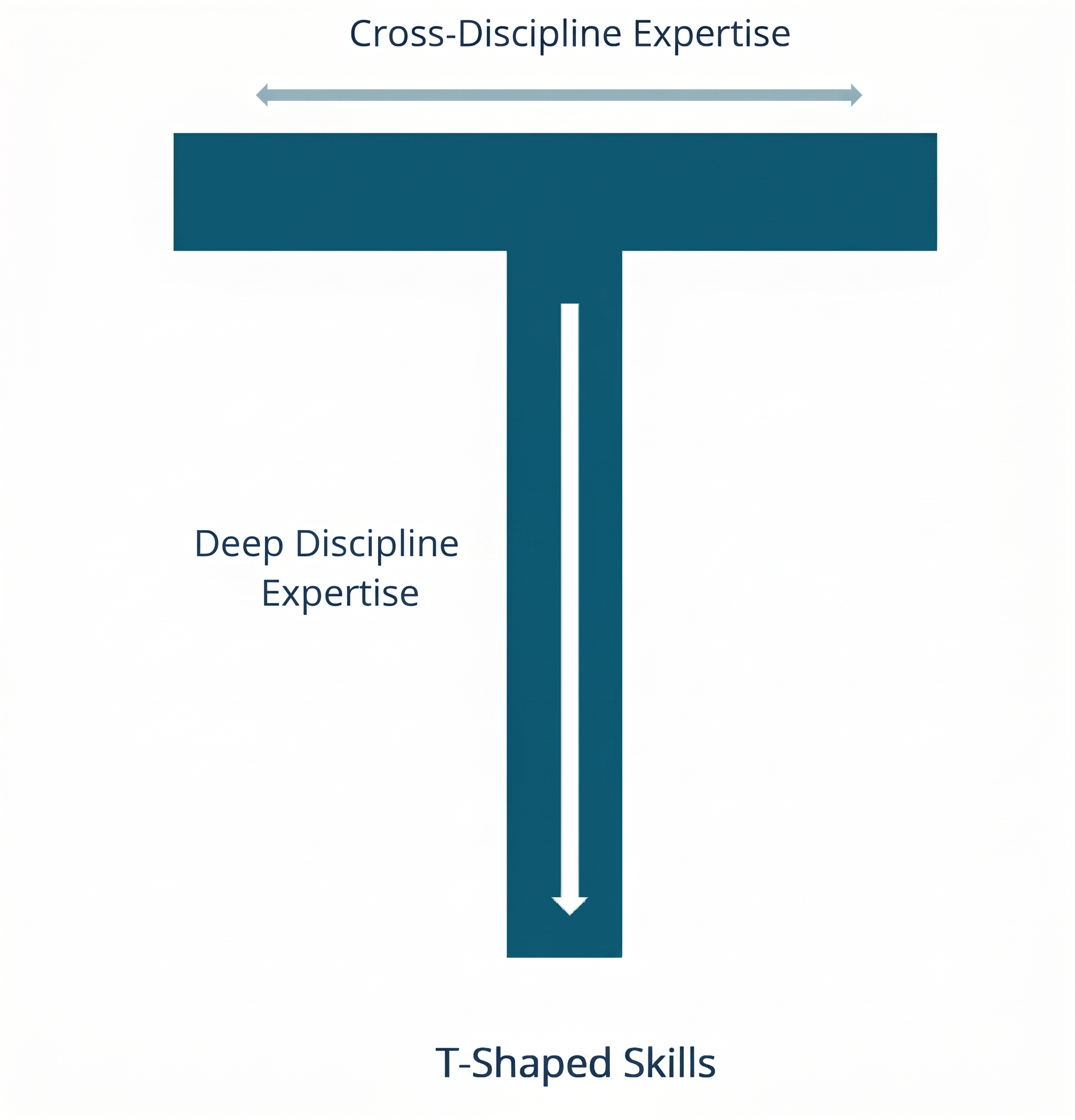 An illustration of the T-shaped skills framework highlighted by Haidee Enriquez, balancing specialized domain knowledge with broader capabilities in AI, data analytics, and human-centric problem-solving.
The distinction matters as AI increasingly takes over predictable work. The goal, then, should not simply be to automate existing responsibilities but to move employees toward work that requires greater judgment, creativity, and human understanding.
Preparing the workforce for what comes next
Gartner forecasts that 80% of common customer service issues will be resolved autonomously by AI by 2029. A separate forecast from Forrester projects that 49% of current customer service jobs will disappear due to AI by 2030. These projections point to a significant restructuring of customer service work, although the extent and pace of change will vary across organizations.
For employees, one of the immediate concerns is how to build experience when some of the routine tasks traditionally assigned to entry-level workers are increasingly automated.
Enriquez stressed that organizations will need to rethink how employees learn, develop, and progress in their careers. Structured training must be complemented by practical exposure to AI, mentoring, job rotations, and opportunities to take on more complex responsibilities earlier.
At MicroSourcing, this commitment is reflected in its TESDA EBET management capability development program, launched in December 2026. The program provides 73 hours of training focused on ethical AI and its integration into business processes, comprising eight hours of face-to-face instruction and 65 hours of online learning through LinkedIn Learning. It is designed to equip management employees with practical AI capabilities that can support transformation across the organization.
The investment recognizes that workforce readiness cannot be achieved through technology training alone. Employees also need critical thinking, problem-solving, communication, empathy, and leadership skills to navigate responsibilities that increasingly require human judgment.
Making productivity gains matter to people
As AI changes the nature of work, organizations will also need to rethink how they measure performance and reward employees. Traditional metrics may no longer tell the whole story. In CX, for example, greater weight will need to be placed on first-contact resolution, customer satisfaction, and the quality of solutions delivered.
Enriquez emphasized that productivity improvements should benefit employees as well as the business. Businesses should consider how AI-driven gains can translate into skills development, career progression, recognition, and rewards.
For MicroSourcing, the m-value of AI transformation should also be reflected in how companies develop their people and enable them to take on more meaningful, higher-value work.
As businesses navigate an increasingly AI-driven workplace, the challenge is not simply to automate more but to make the resulting progress count for the people behind it.
About MicroSourcing Group
MicroSourcing Group is an offshore build-to-scale and managed solutions partner to SMEs and mid-market companies, delivering highly skilled professionals by leveraging our deep labor market knowledge and recruitment expertise. As a pioneer in this non-traditional offshoring model, we have a proven track record in building reliable and ethical extensions of global businesses, enabling profitable growth for clients.
Through its brands, MicroSourcing and Beepo, the Group’s network of 10,000+ professionals supports over 1,000 clients across 13 delivery centers in the Philippines and Colombia. Our corporate presence spans six global locations, with teams operating under a unified framework for governance, data security, and service delivery. Backed by a pool of 200,000+ job-ready candidates and recruitment experience across industries, business sizes, and role complexities, we scale operations from a single hire to enterprise levels, providing the talent, infrastructure, and operational backbone required for growth.
About WTW
WTW is a leading global advisory, broking, and solutions company that provides data-driven, insight-led solutions in the areas of people, risk, and capital. With a focus on helping organizations navigate complex business challenges, WTW works with clients to strengthen workforce resilience, develop talent strategies, manage risk, and improve business performance.
Through its people and human capital solutions, WTW helps organizations address workforce transformation, employee experience, compensation and rewards, health and benefits, and retirement planning. Learn more at www.wtwco.com.
References:
IBPAP - 2028 Industry Outlook and survey findings on AI adoption, job role changes, and workforce reskilling.
Gartner - 2026 AI Scaling Survey and forecasts on agentic AI project cancellations and the future of customer service.
Everest Group / TELUS Digital - Enterprise Generative AI Readiness research.
Forrester Forecast on the impact of AI on customer service jobs by 2030.