
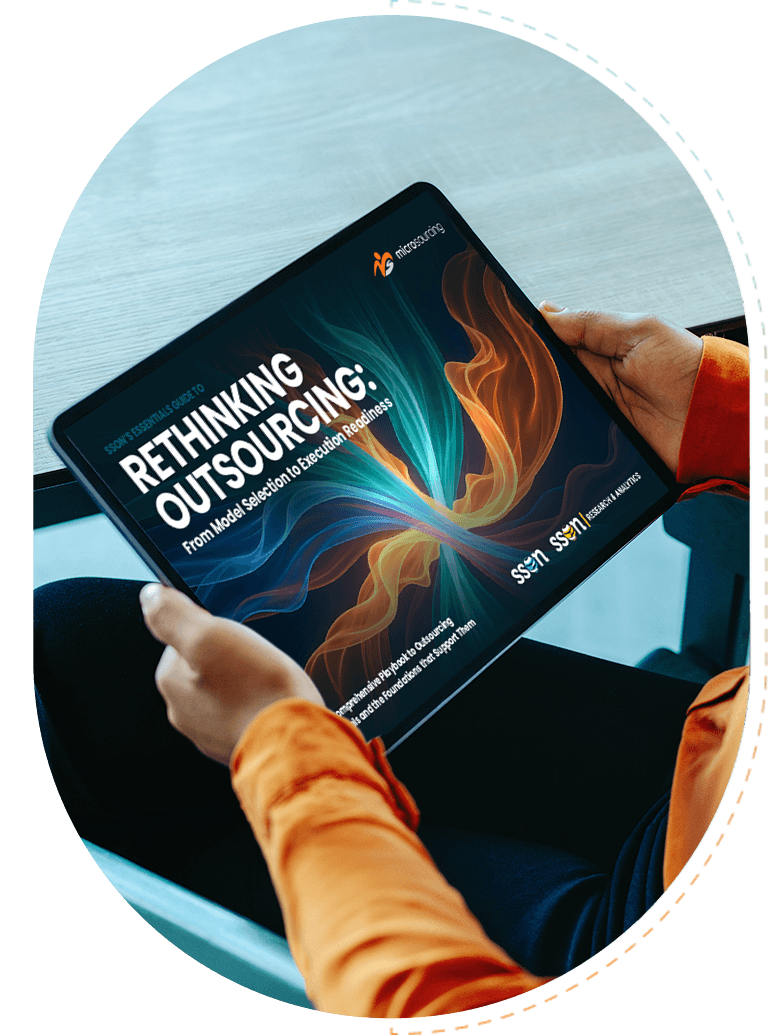
Rethinking Outsourcing: From Model Selection to Execution Readiness
Outsourcing decisions have become more complex, not simpler. With multiple models available, success now depends not just on what you choose, but how prepared you are to execute. This playbook breaks down the shift from model selection to execution readiness, and what it takes to make outsourcing work in practice.Outsourcing is no longer just a cost decision. As operating models evolve, organizations now choose between traditional, hybrid, and specialized approaches, each designed to support different business goals.
But increased choice has introduced a new challenge: complexity. Many organizations struggle not with selecting a model, but with making it work.
This playbook explores how outsourcing success depends on execution readiness, not just model selection.
Download Now
The Outsourcing Landscape Has Changed
Balancing Control and Flexibility
Hybrid Models Are Becoming Standard
Complexity Increases Without Coordination
Outsourcing Is Now an Operating Model Decision
Execution Readiness Determines Success
Many outsourcing initiatives struggle not because the chosen model is wrong, but because the operational foundations behind it are not mature enough to support long-term performance.
Organizations that succeed focus on execution readiness across systems, governance, workforce support, and operational alignment.
Standardized Systems and Shared Tools
Defined Processes and Governance
Workforce and Leadership Alignment
Strategic Partnerships That Support Growth
FAQs Section
Common models include traditional outsourcing, managed services, staff augmentation, and hybrid approaches that combine multiple models.
A hybrid model blends different outsourcing approaches to match work complexity, offering flexibility while maintaining control across functions. Hybrid models are becoming a preferred choice because they allow companies to scale resources, access specialized expertise, and tailor delivery models to different business needs without sacrificing oversight.

Start building your global capability today
Send us a message and our team will reach out within one business day to discuss how we can help you scale with confidence.
About MicroSourcing
MicroSourcing empowers organizations to scale through dedicated offshore and nearshore teams, combining skilled talent, certified operations and trusted delivery to create measurable, long-term impact for businesses and professionals.
We envision a world where businesses of every size, location and industry can access the tools, talent and infrastructure they need to operate and grow - and where highly skilled professionals have access to meaningful opportunities beyond their local job markets.
MicroSourcing operates in the Philippines and Colombia across 13 service delivery centers, servicing 1,000+ clients and over 10,000 employees.
- 8,000+ unique profiles hired across industries and business sizes
- 200,000+ job-ready candidates screened
- 60% of clients began small and then scaled