
Outsourcing in the AI Era: Opportunities Beyond Cost Savings
AI is changing not only how work gets done, but also the skills, operating models and partnerships organizations need to compete. At the same time, cost pressure, talent shortages, regulatory demands and cybersecurity risks are making it harder for businesses to transform using internal resources alone.Across professional services, healthcare and financial services, these pressures are playing out differently. But one theme cuts across all three: the traditional view of outsourcing as primarily a cost-saving strategy is becoming increasingly incomplete.
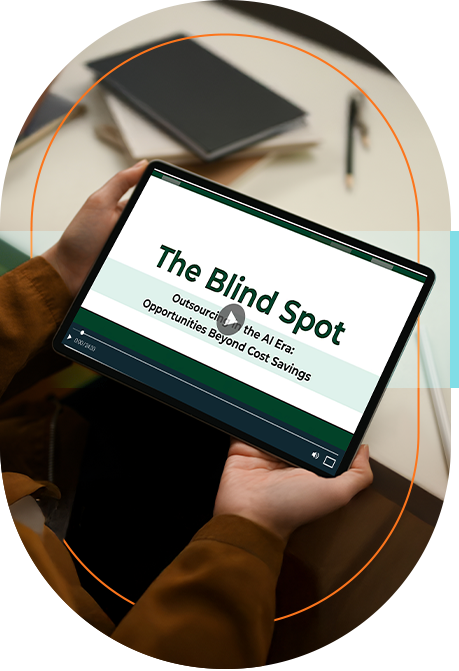
In this on-demand discussion, three industry analysts examine how AI and broader market disruption are reshaping these sectors, where human expertise remains critical and how organizations can rethink outsourcing as part of a more resilient, scalable operating model.
Watch The Discussion
Why AI Is Changing the Outsourcing Equation
Cost Pressure Remains, but the Value Equation Is Changing
AI Is Redefining How Knowledge Work Creates Value
Specialized Talent Is Becoming Harder to Find
Human Expertise Remains Critical
What Disruption Means Across 3 Industries
Professional Services Is Moving Beyond “Rates Times Hours”
AI is challenging delivery models that have historically connected time spent with value delivered. Professional services firms are under pressure to improve outcomes while building a workforce with deeper specialization and broader cross-functional capabilities.
The discussion explores the rise of the “T-shaped” or “full-stack” analyst and why global delivery models may become increasingly important as firms search for these combinations of skills.
Healthcare Is Using Outsourcing as a Pressure Relief Valve
Healthcare organizations are balancing workforce shortages, rising labor costs, reimbursement pressure, administrative workloads and growing demand for transformation.
Outsourcing can create additional capacity by moving appropriate operational work away from constrained internal teams. But as AI becomes more embedded in workflows, healthcare organizations also need greater transparency into how outsourced processes operate so they can retain institutional knowledge, maintain quality and understand how technology is being used.
Financial Services Needs Humans at Critical AI Decision Points
Financial services encompasses organizations with very different operating and regulatory environments, but AI is increasingly influencing processes across the sector.
From risk management and fraud detection to customer service, portfolio management and regulatory compliance, organizations need to determine where human judgment and sign-off remain necessary. That creates a parallel workforce question: what expertise should those people have, and where can organizations find it?
The Relationship Is Shifting From Vendor to Partner
As outsourcing moves closer to transformation, AI-enabled workflows and business-critical operations, transactional vendor relationships become less effective. Organizations increasingly need partners that provide transparency, specialized expertise and clear accountability for outcomes.
That requires greater visibility into processes, stronger knowledge transfer and closer collaboration on how future workflows should be designed, not simply transferring existing work to a third party.
FAQs Section
AI is changing processes, skill requirements and the economics of certain types of work. As organizations redesign workflows around AI, outsourcing can provide access to specialist talent, operational capacity and external expertise that may be difficult to build internally.
The opportunity therefore extends beyond reducing labor costs to helping organizations address capability gaps and support broader transformation.
Yes. Cost pressure remains an important consideration across all three industries discussed in the video.
However, organizations are increasingly balancing cost with other priorities such as access to skills, scalability, transformation, cybersecurity, quality and operational resilience. Cost efficiency is becoming one part of a broader outsourcing decision rather than the only objective.
Human in the loop means retaining human involvement at points where judgment, validation, accountability or specialist expertise is required.
The exact role depends on the process. In financial services, for example, human involvement may be necessary around risk, fraud or regulatory decisions. In healthcare, people remain critical to maintaining quality, understanding workflows and ensuring appropriate oversight of AI-enabled processes.
The discussion highlights growing demand for “T-shaped” talent: people with deep expertise in a particular industry or technology domain combined with broader capabilities across areas such as data, operations, communication, problem solving and business processes.
As AI changes individual tasks, these broader combinations of expertise may become increasingly valuable.
Transparency and knowledge transfer are particularly important. Healthcare organizations need to understand how work is performed, how AI is being used and how outsourced processes connect with their broader operations.
Outsourcing arrangements should also establish clear performance expectations and provide sufficient visibility for organizations to maintain appropriate governance and oversight.
Organizations should look beyond workforce capacity alone and consider whether a potential partner can support the capabilities their future operating model requires.
That includes relevant specialist expertise, transparency into processes and technology use, strong governance, cybersecurity awareness, knowledge transfer and the ability to align delivery with defined business outcomes.

Start building your global capability today
Send us a message and our team will reach out within one business day to discuss how we can help you scale with confidence.
About MicroSourcing
MicroSourcing empowers organizations to scale through dedicated offshore and nearshore teams, combining skilled talent, certified operations and trusted delivery to create measurable, long-term impact for businesses and professionals.
We envision a world where businesses of every size, location and industry can access the tools, talent and infrastructure they need to operate and grow - and where highly skilled professionals have access to meaningful opportunities beyond their local job markets.
MicroSourcing operates in the Philippines and Colombia across 13 service delivery centers, servicing 1,000+ clients and over 10,000 employees.
- 8,000+ unique profiles hired across industries and business sizes
- 200,000+ job-ready candidates screened
- 60% of clients began small and then scaled